Industrial Revolution
The following inventions during the Industrial Revolution. I want you to think about the following for each invention:
- Who built it?
- When was it built?
- What did it help accomplish?
- Which processes were made more effiecient?
- How was it built?
- How did it change life for Americans?
The Cotton Gin

Steam Engine Boat

The "Iron Horse", aka the steam powered locamotive

Erie Canal


Reaper

Telegraph

Interchangeable Parts

We The People
Our new IB planner, "We The People" is all about how we organize ourselves: An inquiry
into the interconnectedness of human-made systems and communities.
The central ideal of this unit is learning about how people create documents to organize their communities.
We'll be asking ourselves the following quesstions about causation and change:
- Causation- What purpose(s) do government documents serve?
- Causation-Why are government documents formed?
- Change-Why do government documents change?
The Articles of Confederation
"The Continental Congress wrote the Articles of Confederation
during the Revolutionary War. The articles were written to give the colonies
some sense of a unified government. Once the thirteen colonies became the
thirteen states, however, each one began to act alone in its own best interest.
A new governing document was needed in order for these new states to act
together, to become a nation.
The Articles of Confederation became effective on March 1, 1781, after all
thirteen states had ratified them. The Articles made the states and legislature
supreme. There was no executive branch. Judicial functions were very
limited.The resulting government was weak. Efforts to make it stronger failed. A convention called in May 1787 to re-write the Articles decided to draft an entirely new Constitution."
Source: CongressForKids.net
The Constitution
Enjoy this School House Rock about the Constitution. It's called "We The People", just like the first 3 words of the preamble to the Constitution, and the name of our unit.
The American Revoltion
Watch these great videos that a teacher named Mr. Striplin has created. It really outlines the battles throughout the American Revolution,
French Indian War
Causes of the Revolutionary War
Liberty Kids
These videos show events leading up to the revolution in a cartoon format (which is always fun to watch)!
The Boston Tea Party
Intolerable Acts
The Midnight Ride of Paul Revere
The Shot Heard Around the World
The Green Mountain Boys
The Second Continental Congress
The Battle of Bunker Hill
Postmaster General- Benjamin Franklin
Washington Takes Command
Common Sense
Independence-Finally!
New York, New York
The Turtle
One Life to Lose
Captain Molly
American Crisis
Across the Delaware
An American In Paris
Sybil Ludington
LaFayette Arrives
The Hessians Are Coming
Valley Forge*
Allies At Last*
The New Frontier
Not yet Begun to Fight
The Great Galvez
In Praise of Ben
Bostonians
Benedict Arnold
Conflict in the South*
Deborah Sampson: Soldier
James Armistead
Yorktown*
Born Free and Equal*
The Man Who Wouldn't Be King*
Going Home*
We the People
Loyalist & Patriots
The Treaty of Paris
The Treaty of Paris created free, sovereign, and independent states. It also created the boundries of land available to the Americans. The United States is all of the land in GREEN.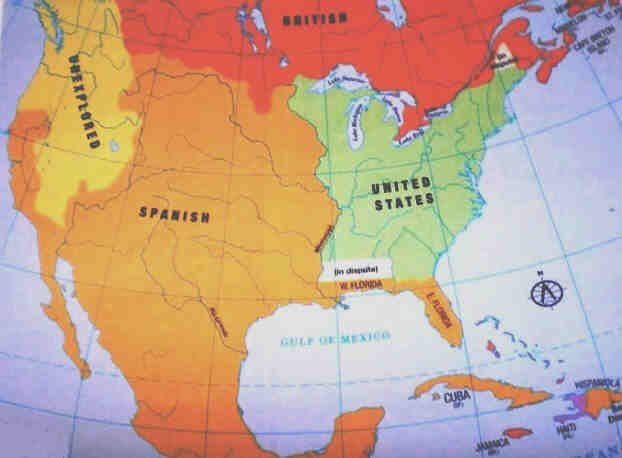
Major Battles of the Revolutions
13 Colonies
Enjoy these awesome Podcasts and videos that some other 4th grade teachers have made around the country to help their students. These videos are VERY helpful in helping you learn the information we're covering in class. During the week of December 8th, please make sure to watch these videos.
European Explorers
Why Explore?
·
Marco
Polo found a land route to China called the Silk Road
o
He wrote a book about his travels, which made
people interested in traveling to Asia
·
Europeans wanted silk, spices, and gold that merchants brought from China
and other Asian countries
o
Travel on the Silk Road was difficult à
Europeans searched for a sea route to
Asia
·
Trading and exploring brought adventure and money to people’s lives
·
New technologies and navigational tools such as
the astrolabe, compass, improved maps, gunpowder, and better ship designs made it easier to search
for water routes to Asia
Major Explorers
Christopher Columbus
Year: 1492
Country: Spain
(King Ferdinand and Queen Isabella)
Goal: Find a
route to Asia by sailing West, make money from gold and spices, spread
Catholic religion
Accomplishments:
Landed in present-day San Salvador, explored the region so other sailors and
merchants could follow his route
|
Vasco Nunez de Balboa
Year: 1513
Country: Spain
Goal: Explore
Central and South America
Accomplishments:
Crossed South American jungles overland and reached the Pacific Ocean,
changed the way Europeans thought North and South American looked
|
Juan Ponce de Leon
Year: 1513
Country: Spain
Goal: Search
for gold and the “Fountain of Youth”
Accomplishments:
Explored present-day Florida
|
John Cabot
Year: 1497
Country:
England
Goal: Reach
Asia by sailing across the Atlantic Ocean
Accomplishments:
Reached and explored Canada, found rich fishing areas so a fishing industry
developed, Europeans began to send more explorers to search these waters for
a passage to Asia
|
Jacques Cartier
Year: 1534
Country: France
Goal: Find a
water route to Asia
Accomplishments:
Explored the St. Lawrence River, French began to send more explorers to
settle in this area
|
Henry Hudson
Year: 1609 and
1610
Country:
Netherlands and England Goal:
Search for the “Northwest Passage” – a water route to Asia through North America
Accomplishments:
Explored Hudson Bay and Hudson River, allowed Dutch and English to claim land
in these regions
|
Ferdinand Magellan
Year: 1519
Country: Spain
Goal: Sail
west, go around South America, cross the Pacific Ocean, and return to Spain
Accomplishments:
One ship of the original five returned to Spain in 1522, Magellan’s crew was
the first to circumnavigate the world
|
Columbian Exchange
·
The Columbian Exchange is the name for the movement of plants, animals, and people
between North America and Europe following Columbus’s voyages

Impact of Exploration
on Native Americans
·
Conflict
o
Europeans brought diseases that killed the Native Americans
o
Europeans treated Native Americans very harshly
– Native Americans were enslaved and
forced to work on farms and in mines
o
Europeans forced Native Americans to change their language, religion, and
culture
·
Cooperation
o
French
settlers traded fish, animals, and
furs with Native Americans
o
Native Americans often helped European explorers
by working as guides
New Spain
·
Spain began to settle colonies in North and
Central America – called these colonies New
Spain
·
The goals of the Spanish settlers were to...
o
Find valuable minerals like gold and silver
o
Start missions
to teach the Catholic religion to Native Americans
o
To start successful farms to grow crops like squash, corn, and beans
·
Spanish colonists enslaved and overworked the Native
Americans in mines and on farms à as Native
American slaves died from being overworked, slaves from Africa were brought to
North America to work
You should be familiar with latitude, longitude, continents and oceans.
**Don’t forget to review past Social Studies and Science units for the
30% review section of the test!**
Native American Tribes
We have been researching the Native American Tribes below in class. Please visit the hyperlinked materials to find out more information about each tribe. The books we have in class have been really helpful, but these resources may also be a wealth of knowledge for you. E River's Media Center Website also has some of the best resources for you to use for this project.
Remember, the areas we are studying as a class are: climate, natural resources, land forms, homes, clothes, food, culture/traditions, and technology. You probably won't find anything for land forms if you type in something like "Pawnee land forms" into any search engine, so do some deeper thinking. If you know that the Pawnee live in the Great Plains, look up information on the landforms you can find in that region.
- Inuit
- Nez Perce
- Seminole
- Pawnee
- Kwakiutl
Map Skills
Use the following website to help you with the MAP SKILLS we're covering in class.
Longitude and Latitude Game: http://www.kidsgeo.com/geography-games/latitude-longitude-map-game.php

No comments:
Post a Comment